preloader

A Field of Moving Air

There's actually a ton of stuff going on up there, but you can't see all the air currents at first.

Soft gradients stretch across the horizon. Light particles shimmer faintly as they drift through open space.

There are no walls, no heavy terrain, no obstacles to crash into.
Only air. Only motion.

The objects floating in this space respond to subtle environmental forces. They glide naturally, following patterns you cannot fully see.

Your role is quiet.

You are not here to force movement.
You are here to stabilize it.

Movement Without Direct Control

Each floating object moves continuously
from the moment it appears.

There are no stop commands.

No direct dragging.

No hard directional overrides.

Instead, every object:

  • Maintains a steady velocity
  • Responds gradually to nearby influence
  • Retains momentum even after passing an anchor

Drift is predictable — but only if you understand space.

Small corrections early can prevent large deviations later.
You really gotta think ahead here - if you just react after stuff happens, you're screwed.

Understand Anchor Fields

Subtle Forces That
Shape Motion

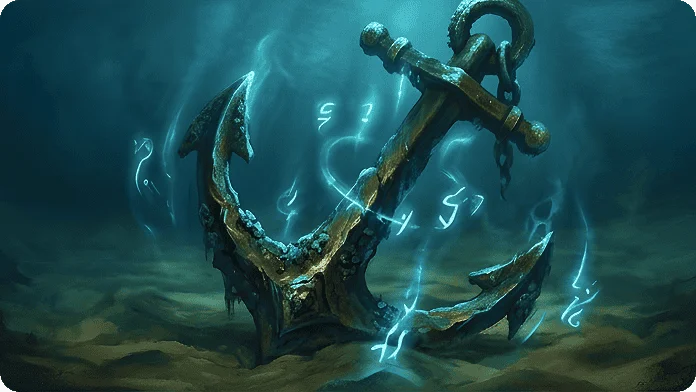
When you place an anchor, it does not freeze objects.

It creates a gentle gravitational field.

Within its radius:

  • Trajectories curve softly
  • Speed adjusts slightly
  • Direction bends over distance
The influence is cumulative.
Multiple anchors overlap and combine their pull.
Too many anchors can create unstable turbulence.
Too few may leave drift uncontrolled.
Trust me on this one - using fewer
anchors actually works way better.
Explore the Motion System

Controlled Physics, Designed for Clarity

The physics are kept pretty simple on purpose - nothing too crazy.

Core Principles:

  • Objects follow consistent wind vectors.
  • Anchor pull decreases with distance.
  • Movement transitions are smooth and gradual.
  • Sharp redirection is impossible — only curves exist.
  • Entry into safe zones must be aligned, not abrupt.

You are shaping flow fields, not pushing objects.

When you get it just right, it almost looks effortless - like you hardly touched anything.

Efficiency scoring is based on:

  • Minimal anchor placement
  • Clean curvature
  • Stable arrival
  • Absence of turbulence

Complexity Through Space, Not Speed

As you rise through the layers of the sky, the environment evolves.

Early Layers

Early Layers

  • Single object drift
  • Large safe zones
  • Wide open movement space
  • Generous anchor allowance
Mid Layers

Mid Layers

  • Multiple drifting objects
  • Crossing trajectories
  • Directional wind shifts
  • Limited anchor placements
Upper Layers

Upper Layers

  • Rotating wind currents
  • Moving safe zones
  • Temporary anchor lifespan
  • Narrow arrival corridors
  • Multi-object synchronization challenges

What Players Notice

Elena P.
Elena P. month ago
★ ★ ★ ★ ★

"The way those objects just glide into the safe zones is so satisfying! Really smooth movement. There's no sudden motion, just smooth redirection. I appreciate how calm the entire experience feels. It makes you slow down and think instead of just rushing through."

Daniel R.
Daniel R. 2 month ago
★ ★ ★ ★ ★

"I love that you never directly control the objects. The anchor thing is clever — you can't just spam them everywhere and pray it works. Every placement requires thought because the influence builds gradually. It's subtle but very strategic."

Sofia M.
Sofia M. month ago
★ ★ ★ ★ ★

"The soft sky gradients and quiet drift make it feel almost meditative. Even when levels become more complex, the atmosphere never feels stressful. You can tell they really thought this through."

Marcus L.
Marcus L. 4 month ago
★ ★ ★ ★ ★

"Later stages really test your understanding of overlapping fields. You can't just place anchors randomly — the interactions matter. It's super satisfying to watch everything flow together perfectly after you've planned it all out."

Aisha K.
Aisha K. 3 month ago
★ ★ ★ ★ ★

"The minimal visual style makes the physics easy to read. You can clearly see how each anchor influences trajectory. It's got this nice balance to it, not all crazy and hectic like some games."

Thomas W.
Thomas W. 2 month ago
★ ★ ★ ★ ★

"This is one of the most graceful physics puzzles I've played. Nothing forced or exaggerated. The calm pacing combined with strategic depth makes it stand out."